Notes from the morning alignment class on why precision is not fussiness, and what happens to a body that practises for years without it.
Nine people on the floor. Morning class in Tapovan, a little after nine.
I ask for a forward bend. Within about two seconds I know which of them will still be climbing this hill comfortably at sixty, and it has nothing to do with how far down they go. I am watching one thing: the crease at the top of the thigh. Is anything happening there, or is the spine doing all the work while the hip stays shut?
Usually the crease does nothing at all, and instead the back rolls, the head hangs, something pulls behind the knee, and because that pull arrives with a satisfying intensity it gets read as progress rather than as a warning. So they stay. They breathe into it. They come up feeling they have worked.
They have done the shape. They have not done the asana. Those are not the same thing, and the difference is not cosmetic. Over ten years it is the difference between a hip that still moves and a labrum that has been quietly filed down at its edges.
I taught physics before I taught yoga, and left that work in 2022 to start Prakruti. One habit came across with me and never left: do not accept a result without knowing the mechanism. It is an awkward habit in a yoga room. It is also the only thing that has kept my students out of trouble.
Four questions, before you move
Before entering any posture, you should be able to answer four things. What is this asana asking of me? What is it teaching, and what does it target? What is happening in the joints, the breath and the nervous system while I hold it? And what exact alignment lets those things happen instead of something else?
Cannot answer them? Then you are not practising yoga. You are rehearsing a silhouette, and a body left to make a silhouette will always take the cheapest route to it.
In Uttanasana the cheap route is rounding the lumbar spine instead of tipping the pelvis over the heads of the femurs, in Trikonasana it is dumping weight into the front hip and letting the underneath waist collapse, and in Padmasana it is wringing the knee because the hip has refused to rotate and something has to give. Each time, the photograph comes out fine. The intention of the posture never happens at all.
Loose is not the same as free
Here is the part the modern class has stopped saying out loud.
Three things hold a joint together: how the bones fit, the ligaments and capsule wrapped around them, and the muscles crossing them. Muscles are built to lengthen and come back. Ligaments are not. Ligament is largely passive tissue, and loaded again and again at the end of its range it creeps, it lengthens, and it does not fully return. You gain range. You lose the brake that was keeping the joint honest, and you do not feel the trade happening.
Once that brake is gone the muscles have to hold the joint together instead, and if the practice has only ever stretched, those muscles were never asked to do it. That is how a practitioner ends up extremely open and extremely fragile in the same body. Somewhere between five and fifteen percent of people already have naturally lax joints, more often women, and for them a class built entirely around going deeper is not generosity. It is an accelerant.
The injuries that follow are not dramatic, which is exactly why they get missed. An ache at the sitting bone that never fully clears, from years of folding with a rounded pelvis and hauling on the hamstring where it attaches to the bone. A pinch at the front of the hip that turns out to be a labrum worn at the rim, often in a hip whose bone shape was never going to permit that depth. A shoulder that slides forward in Chaturanga because the elbows flared and the rotator cuff was never recruited. A lower back that is tight every single day because it has spent years doing the job the hips declined.
In the research on hip labral tears, something like three quarters of them cannot be traced to any single incident. They accumulate. Which is another way of saying they are the same small misalignment, repeated a few thousand times, on a body that had no idea it was repeating anything.
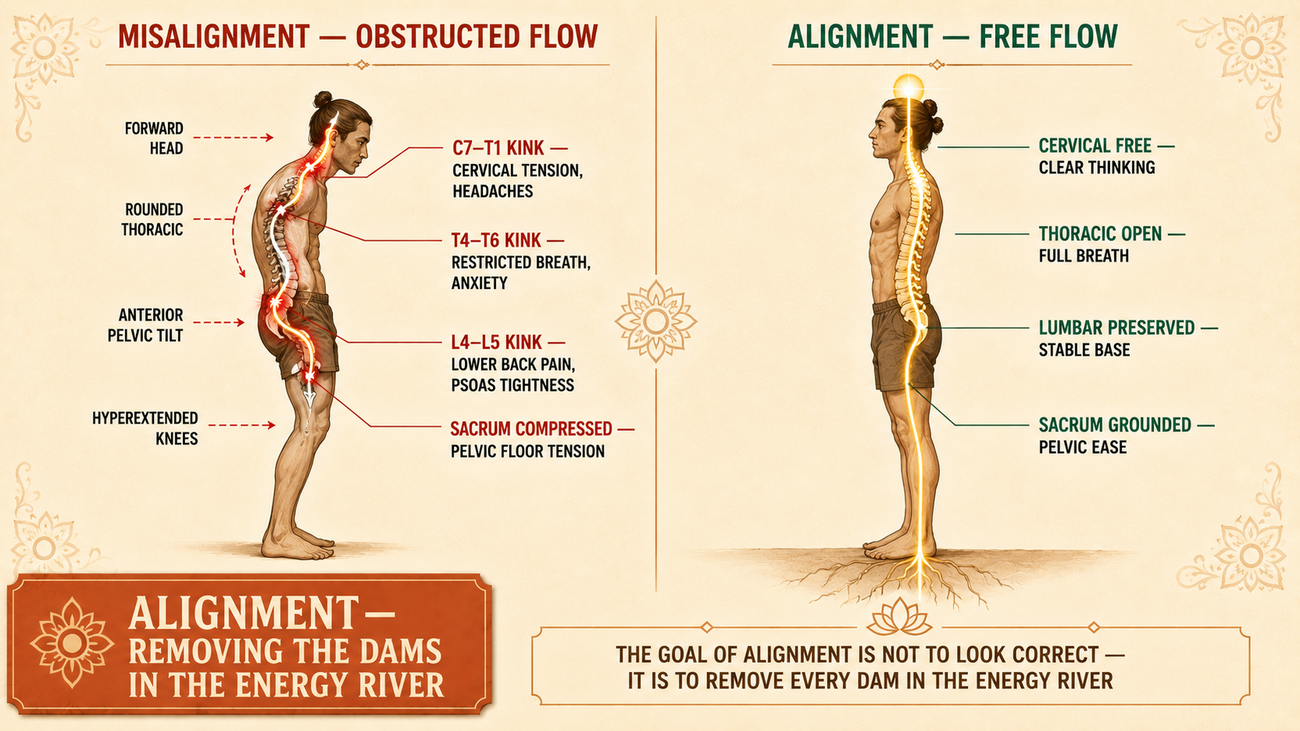
From our alignment course material. The goal is not to look correct. It is to remove the places where the flow stops, because the body pays for a kink somewhere further along the chain.
It is through the alignment of the body that I discovered the alignment of my mind, self, and intelligence.
What Guruji was actually saying
B K S Iyengar gets reduced to the teacher who was fussy about the little toe. People say it as a joke. They have missed him completely.
His position was that the body is not the obstacle to yoga but the instrument of it, and that an instrument out of tune will produce noise no matter how sincerely or how devotedly you happen to play it. A crooked body means a crooked mind, he said. The brain of a yogi runs from the sole of the foot to the crown of the head. That second line sounds like poetry until you have spent the better part of a year trying to get one student to feel the inner heel, at which point it stops being poetry and reads as a plain description of how far attention has to travel before a posture becomes real.
He was blunt that asana done without knowledge and without supervision causes harm, and that the harm often arrives late. Light on Yoga puts its cautions before its postures. He insisted on graded progression and treated speed and ambition as the enemy of the work. Props came from the same place. A wall, a belt, a bolster, a chair are not concessions for the weak, which is how most people read them the first time a teacher hands one over. They are instruments of accuracy. They let a body enter the correct action of a posture before it has the length or the strength to arrive there on its own, so that what gets rehearsed over and over is the right pattern rather than the compensation that would otherwise be learned in its place.
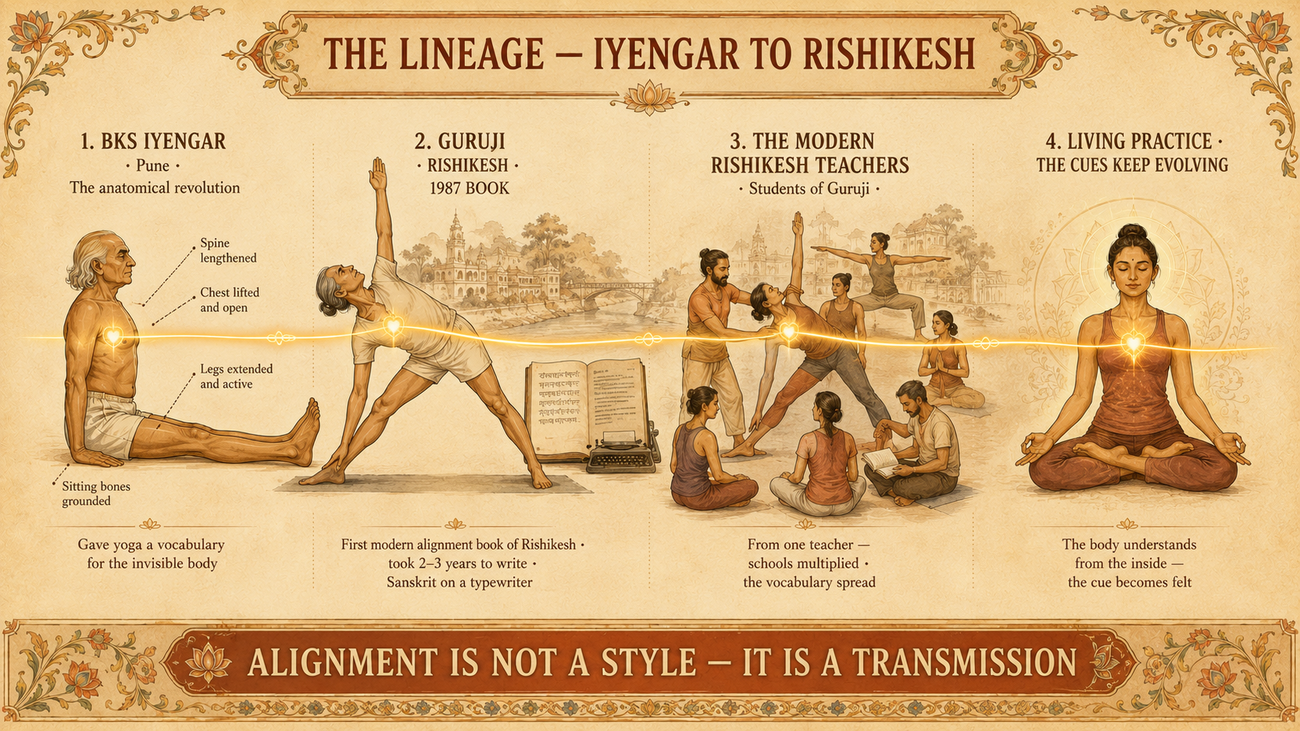
From Pune to Rishikesh. Alignment is not a style you can pick up from a video, it is a transmission, and it took decades to arrive in these rooms.
I learned asana inside that tradition. Later I added Mukunda Stiles’ Structural Yoga Therapy to it, which gave me a way to assess a specific body rather than teach a generic one. My own guru comes from the Kaula Marga lineage of Tantra, so the goal was never in doubt. The argument has only ever been about the method.
Every tradition reached the same warning
This is not one school’s obsession. Read the sources and you find them saying it in their own vocabularies, centuries apart.
Patanjali spends two words on asana: sthira sukham asanam. Steady and at ease. Not deep, not photogenic. Steady, and without strain. He then tells you how it is achieved, through the loosening of effort and a settling of attention on the infinite, and what it finally gives, which is a freedom from being knocked about by the opposites. Read that carefully and you notice something uncomfortable. A posture you are gripping and enduring does not qualify as an asana at all.
The Hatha Yoga Pradipika lists asana first and names its fruits without decoration: steadiness, freedom from disease, lightness of the limbs. Elsewhere it lists what destroys a practice, and sitting near the top of that list, beside overeating and restlessness, is over-exertion. A fifteenth century text is already warning practitioners against trying too hard. The Gheranda Samhita narrows eighty four lakh postures to eighty four, then to thirty two worth a human being’s time. Nobody in the tradition was collecting shapes. They wanted a small number of them understood completely.
Krishnamacharya, who taught almost everyone the modern world learned from, held that the practice is fitted to the person and never the reverse, and that breath leads movement. Pattabhi Jois built something faster out of the same lineage, but even there the safeguard is a precision system: tristhana, posture and breath and gaze held as one thing, plus the bandhas. What travels the world now as flow has largely kept the speed and dropped the three things that made the speed survivable. I will say plainly what most schools will not. A heated, fast, set-sequence class is the wrong entry point for a body that already hurts, because the pace prevents you from feeling what the pelvis is doing, and the compensation that caused the pain gets rehearsed instead of corrected.
Sivananda holds twelve postures with long quiet holds and rest between them. The yin tradition, through Paul Grilley’s work on skeletal variation, arrives from the opposite direction at the identical conclusion: your bones are not your teacher’s bones, so the posture cannot look the same on two people, and chasing the picture rather than the sensation is how joints get injured.
Different centuries. Different languages. One agreement. Awareness before range, steadiness before depth, and the body understood before it is asked for anything.
One asana, all asanas
There is a reason Guruji could spend an hour on Tadasana, and a reason our morning class often spends the first twenty minutes standing still while everybody quietly wonders when the yoga starts.
All the intelligence of the body is available inside a single posture. Understand one completely and you hold the key to the rest. Learn how the head of the femur settles back into the socket so the pelvis can move freely over it, and in that one moment you have solved something in Uttanasana, in Trikonasana, in Virabhadrasana and in Janu Sirsasana together. Learn how the outer upper arm rolls back so the shoulder head stays seated, and Chaturanga, Adho Mukha Svanasana and Sirsasana all become a different question.
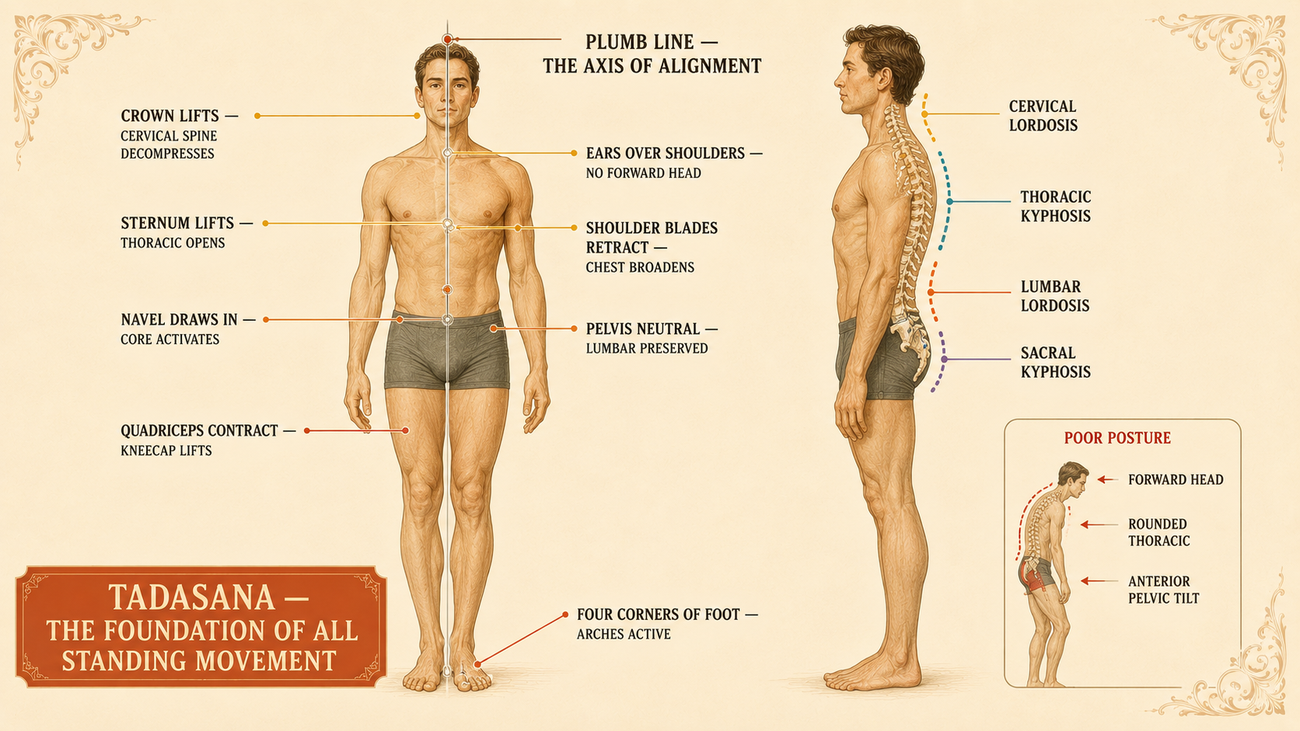
Tadasana as we teach it: every biomechanical law of the practice held inside one still posture, from the four corners of the foot up to the lift of the crown.
This cuts both ways, and here is where most practitioners get caught. If one asana carries the intelligence of all of them, then one misunderstanding travels exactly as far. Gripping the front hip is not a Trikonasana problem. That is your hip. It will follow you into every posture you enter for the next decade, quietly and without complaint, and nobody in any class will mention it to you because from the outside you look perfectly fine.
Every asana has its own energy, its own target, its own direction. They are not interchangeable. Treating them as a queue of shapes to get through is precisely how a practice turns into wear.
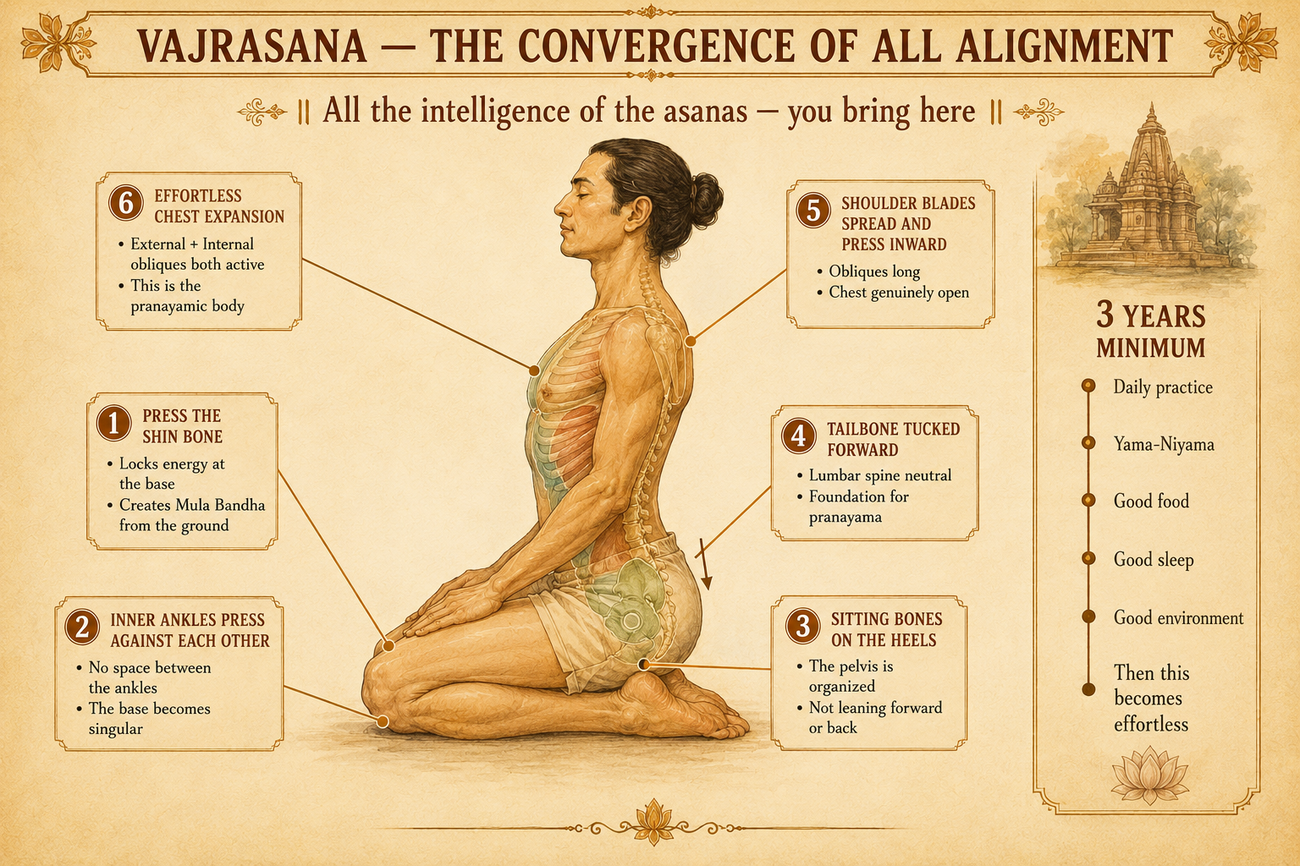
Vajrasana, where everything converges. Inner ankles together, sitting bones on the heels, tailbone forward, shoulder blades spread. Simple to describe, and it took me years.
How we actually practise it
None of this needs an elaborate sequence. It needs a slow one, with something that tells you the truth. Use a wall or a prop as feedback, hold long enough to feel what you are doing, and give each posture one clear question to answer.
- Mountain Pose at the wall (Tadasana): heels, sacrum and upper back lightly touching, then find where the weight really falls through each foot. The wall reports the tilt you cannot feel standing on open floor.
- Reclined Big Toe Pose with a belt (Supta Padangusthasana): belt around the raised foot, the other leg long with the heel pressing away. You are learning hip flexion with a neutral lumbar spine, which is the lesson every forward bend needs first.
- Standing Forward Bend to blocks or a chair (Uttanasana): hands on blocks or a chair seat, knees soft, tipping from the hip crease and not the waist. Stop the moment the lower back begins to round. That point is your honest range today.
- Triangle at the wall with a block (Utthita Trikonasana): back body against the wall, lower hand on a block, both sides of the waist equally long. The wall stops the chest rolling down, which is where this posture is usually lost.
- Downward Dog with a belt above the elbows (Adho Mukha Svanasana): belt looped just above the elbows at shoulder width, hands pressing evenly, outer upper arms rolling back so the shoulders stay stable instead of creeping towards the ears.
- Supported Bridge over a bolster (Setu Bandha Sarvangasana): pelvis resting on a bolster or folded blankets, feet grounded, chest opening without the lower back gripping. Long and quiet teaches the front body to lengthen without force.
- Even breath in stillness (Sama Vritti): sit or lie down and make inhale and exhale the same measured length for a few minutes. Breath is the most honest alignment feedback you own, because it shortens the instant you overreach.
- Conscious rest (Savasana): lie supported with the spine long and let the body absorb what it just learned. The pattern gets written during the rest, not during the effort.
Carrying it off the mat
Take one asana this month and refuse to move on from it. Ten minutes, three or four times a week, a wall or a belt, the same question asked of it every single time. That is worth considerably more than an hour of unexamined flow, and it happens to be the only way body literacy actually gets built rather than talked about.
When you go to a class, listen for whether the teacher tells you what the posture is for and where the movement should originate. If nobody says, ask. Any teacher worth staying with will be glad you did.
And when you catch yourself watching the person on the next mat go lower, come back to what you are here for. The posture is a doorway. Doorways only work if you are facing the right way when you walk through.
A GENTLE NOTE
This is for a healthy body building understanding, and for a settled, familiar stiffness. It is not for an acute injury, a recent flare, or a joint that pinches or gives way. Sharp pain, numbness or a catching sensation means come out and get help, not breathe through it. If you are carrying an injury, are pregnant, or are managing a medical condition, work one to one with a qualified yoga therapist or your doctor before adding any of this to your practice.
Learn to know more about yoga you can visit our yoga school and join 200 hour yoga teacher training in rishikesh and 300 hour yoga teacher training in rishikesh